Amarone della Valpolicella: The Making, Market and Meaning of Italy's Most Iconic Red
From appassimento lofts in Valpolicella to fine-dining lists in New York, Tokyo and London — how Amarone became one of the most powerful identity wines in the Italian portfolio, and what export buyers expect today.
Few Italian wines carry the symbolic weight of Amarone della Valpolicella. Born from the patient drying of Corvina, Corvinone and Rondinella grapes, raised in oak for years before release, and priced as a serious fine wine on every continent, Amarone is the wine that put the Veneto on the global map of premium reds. For Italian wineries with export ambitions, understanding how Amarone is made, sold and perceived abroad is essential — even if you don't produce it yourself.
1. What Amarone actually is
Amarone della Valpolicella DOCG is a dry red wine produced in the Valpolicella zone, north of Verona, between the shores of Lake Garda and the Lessini mountains. It is made from the same indigenous grapes used for Valpolicella Classico — Corvina (45–95%), Corvinone (up to 50%, partially substituting Corvina), Rondinella (5–30%) and small percentages of other authorised local varieties.
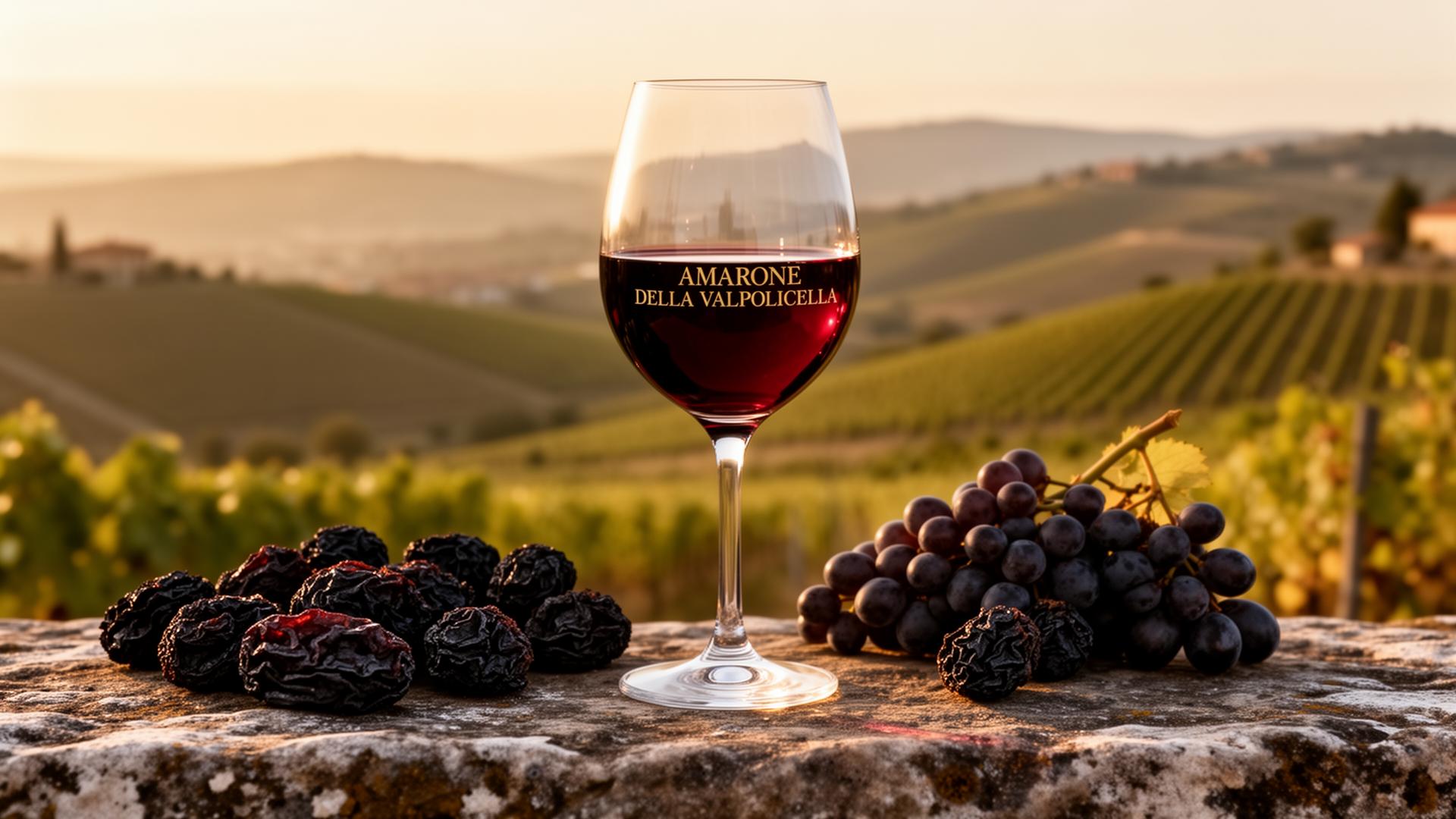
What makes Amarone unique is the appassimento: after harvest, selected bunches are laid on bamboo racks, wooden trays or plastic crates inside well-ventilated drying lofts (the fruttai) for roughly 100 to 120 days. The grapes lose 30–40% of their water, concentrating sugars, acids, polyphenols and aromatic precursors. Only then are they pressed and slowly fermented, producing a dry wine of typically 15–17% alcohol with remarkable depth and longevity.
2. The DOCG rules every buyer should know
Amarone became DOCG in 2010, and the production rules are strict — a useful filter when evaluating producers and price points:
- Minimum ageing: 2 years from 1 January following the harvest; 4 years for the Riserva
- Minimum alcohol: 14% vol., though most commercial Amarone sits between 15% and 16.5%
- Maximum yield: 12 tonnes per hectare in the vineyard, with a further drying loss of 30–40%
- Geographic mentions: 'Classico' (the historical heart of Valpolicella, west of Verona) and 'Valpantena' (a single valley north of the city) are permitted on the label
- Residual sugar: legally dry, but styles range from very dry (under 5 g/l) to richly off-dry (12–18 g/l), a stylistic choice that strongly affects market positioning
3. The two stylistic schools
Buyers and sommeliers today recognise two broad stylistic camps within Amarone, and matching the right style to the right market is critical:
Traditional / classical Amarone
Long ageing in large Slavonian oak botti, drier finish, savoury and almost balsamic profile, dried cherry and tobacco aromas, firm tannic structure. Producers such as Bertani, Quintarelli, Giuseppe Quintarelli, Brigaldara and Tommasi (in their classic line) define this style. It performs well in mature wine markets — UK, Germany, Switzerland, Scandinavia, Japan — where on-trade sommeliers value restraint and food pairing.
Modern / international Amarone
Shorter ageing in smaller French barriques, rounder mouthfeel, more residual sugar, riper black-fruit profile, often higher alcohol. Producers including Allegrini, Masi (in some cuvées), Zenato and several boutique estates lean this way. This style finds traction in the United States, China, Brazil and emerging Asian markets, where consumers reward hedonistic, immediately accessible reds.
4. The pricing ladder, ex-cellar and on shelf
Amarone occupies a clearly premium tier in the Italian wine landscape. Indicative 2026 reference prices, based on what international importers are paying and what consumers see on shelf and on list:
- Ex-cellar (producer to importer): €18–€35 per bottle for entry and mid-tier Amarone; €45–€90+ for top single-vineyard and Riserva bottlings
- Retail abroad: €35–€60 for accessible labels, €70–€150 for established names, €200+ for cult bottlings (Quintarelli, Dal Forno, Giuseppe Quintarelli Riserva)
- By the glass in HoReCa: €14–€22 in upper European fine dining; $20–$35 in US steakhouses and Italian restaurants
- Bottle on premium wine list: typically 2.8–3.5x the import price, with Amarone often appearing in the 'collector' or 'reserve' section of the list
This pricing structure means Amarone is rarely a volume play. For most exporting wineries, it functions as the flagship — the bottle that anchors the portfolio's perceived value and pulls along Valpolicella Ripasso, Valpolicella Classico Superiore and the entry-level Valpolicella.
5. Where Amarone sells abroad
According to Consorzio Tutela Vini Valpolicella data and trade observation, Amarone is among the most export-oriented Italian DOCGs, with roughly 65–70% of production sold outside Italy. The leading markets in 2025–2026 are:
- Germany — the historical number one market, dominated by specialist importers and high-end retail chains
- United States — the second largest by value, concentrated in fine-dining Italian restaurants and steakhouses in NY, Miami, Chicago, LA
- Scandinavia (Sweden, Norway, Denmark, Finland) — where state monopolies actively list Amarone as a premium reference; Systembolaget and Vinmonopolet routinely tender for Amarone selections
- United Kingdom — concentrated in independent merchants (Berry Bros., Lea & Sandeman, Hedonism) and Michelin-starred Italian restaurants
- Switzerland — extremely high per-capita consumption of premium Amarone, with strong Italian-Swiss cultural affinity
- Canada (Ontario, Quebec, Alberta) — LCBO and SAQ Vintages programs regularly feature Amarone, both general list and reserve releases
- Japan, South Korea and Singapore — growing Asian markets where Amarone is positioned as an alternative to Bordeaux Right Bank wines
- Brazil and Mexico — emerging Latin American demand, particularly for modern, riper styles
6. The Ripasso effect: building the full Valpolicella ladder
No serious export discussion of Amarone is complete without Valpolicella Ripasso DOC — 'the baby Amarone'. Made by re-fermenting Valpolicella Classico Superiore on the still-warm Amarone pomace, Ripasso captures part of the appassimento character at roughly half the price. For importers, the typical Veneto portfolio looks like this:
- Valpolicella DOC — the entry point, light and fresh, €8–€14 retail
- Valpolicella Classico Superiore — slightly more structured, €12–€18 retail
- Valpolicella Ripasso DOC — the volume driver of the premium tier, €15–€25 retail
- Amarone della Valpolicella DOCG — the flagship, €35–€150+ retail
- Recioto della Valpolicella DOCG — the sweet, raisinated counterpart, mostly half-bottles, €30–€60 retail
Selling Amarone in isolation is harder than selling the full ladder. Importers want a coherent range that lets them place wines across price points and occasions — the same restaurant can pour Valpolicella by the glass at lunch and Amarone by the bottle at dinner.
7. What international buyers ask in 2026
Working with importers and monopoly buyers across Europe, North America and Asia, the same questions come up again and again when evaluating an Amarone listing:
- Classico or non-Classico? The Classico zone still commands a premium of roughly 15–25% at retail
- How long was the appassimento, and where? Traditional fruttai with natural ventilation are increasingly valued over fully climate-controlled rooms
- Oak regime — Slavonian botti, French tonneau, barrique, or a blend? Buyers want a clear stylistic statement, not a generic 'oak-aged'
- Residual sugar — disclosed transparently? Many importers now ask for the exact figure to position the wine accurately on the list
- Sustainability — RRR (Reduce, Respect, Retrench) or Equalitas certification, organic conversion, carbon footprint? Scandinavian monopolies and major UK retailers now treat this as a hard filter, not a nice-to-have
- Vintage availability and allocation discipline — can the producer guarantee a coherent multi-year supply, or will the importer face stock-outs after the first year?
8. Practical takeaways for producers and exporters
If your winery produces Amarone — or you're building a Veneto portfolio for a multi-region distributor — a few principles consistently separate successful export programs from the rest:
- Lead with the full Valpolicella ladder, not Amarone alone — importers buy ranges, not single SKUs
- Pick a stylistic side (traditional or modern) and articulate it clearly in tech sheets, masterclasses and trade tastings
- Protect price discipline across markets — Amarone is a fine wine, and grey-market discounting destroys long-term positioning faster than in any other Italian category
- Invest in sommelier and importer education — appassimento is a powerful story, but only if it's told well; trade masterclasses in the importer's market consistently outperform generic shelf promotions
- Treat sustainability certification as a sales tool, not a cost center — it is now the entry ticket to Scandinavia, Canada and a growing share of UK and German on-trade
Amarone is not a wine you sell on price. It is a wine you sell on identity — the appassimento, the Valpolicella hills, the producer's hand. Get the story right, and the bottle sells itself.
For Italian wineries serious about international growth, Amarone is more than a product line — it is a benchmark of how the world reads premium Italian red wine. Whether you produce it, distribute it or simply compete with it, the standards Amarone has set for storytelling, pricing and stylistic clarity now apply to almost every serious Italian fine wine on the global market.