Sauvignon Blanc in Italy: When Northern Elegance Challenges New Zealand Intensity
From Friuli to Alto Adige, Italy produces Sauvignon Blanc of extraordinary finesse. A deep comparison with Marlborough's blockbuster style and the estates proving Italian white wine belongs on the world stage.
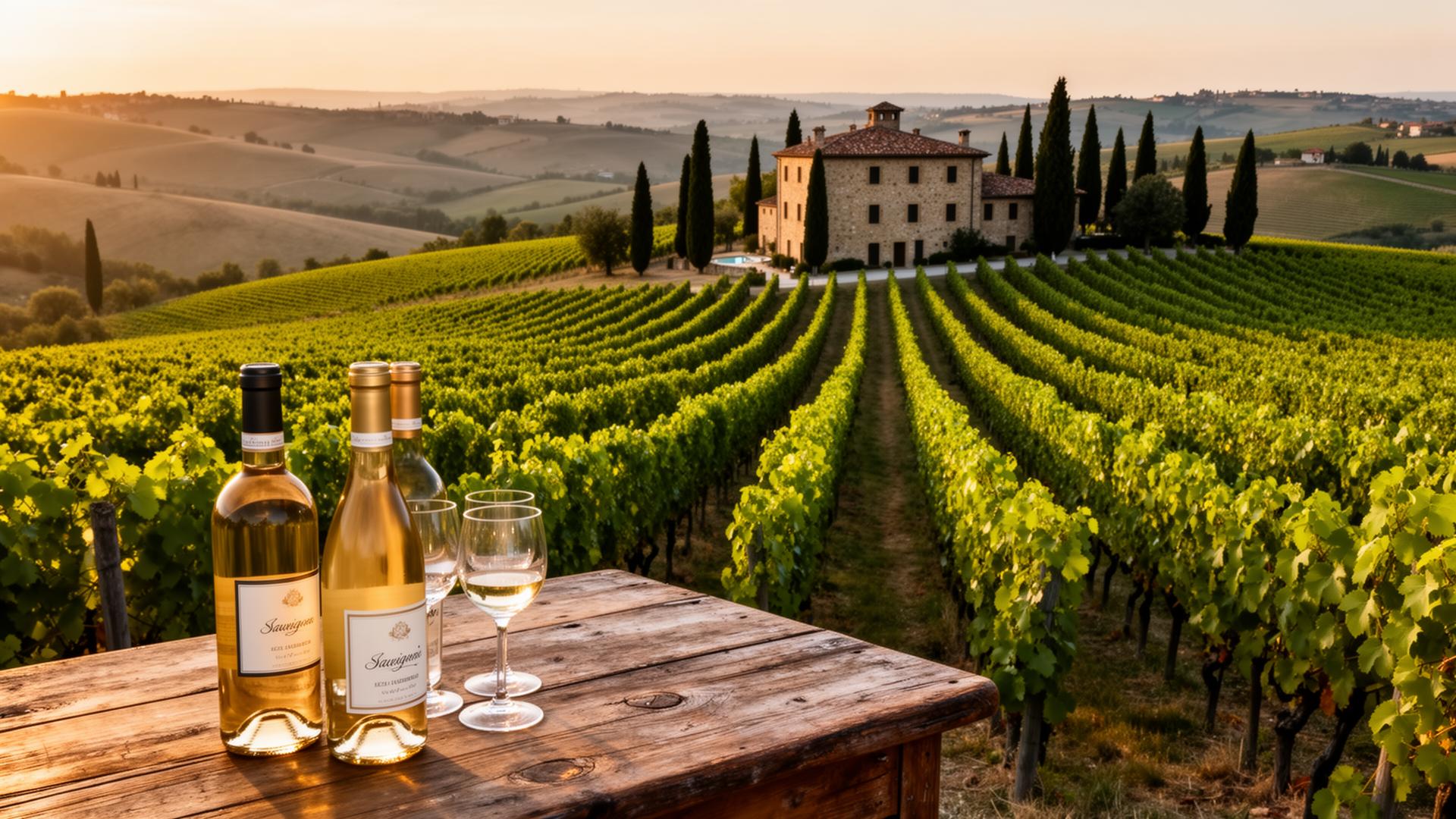
Sauvignon Blanc is one of the most planted white grape varieties in the world, and New Zealand — particularly Marlborough — has become its global poster child. But Italy, especially the northeastern regions of Friuli-Venezia Giulia, Alto Adige, Trentino and parts of Veneto, has quietly built a Sauvignon tradition of remarkable depth and elegance. The contrast is stark: Marlborough delivers explosive tropical fruit, passionflower and gooseberry with almost electric acidity; Italy offers a more mineral, floral and herbaceous profile, with restrained power and extraordinary ageing potential.
The New Zealand paradigm: Marlborough's global dominance
Marlborough's Wairau and Awatere valleys produce Sauvignon Blanc that is instantly recognisable: pungent boxwood and cat's pee aromatics, ripe passion fruit, grapefruit zest and razor-sharp acidity. Producers like Cloudy Bay, Greywacke, Dog Point and Villa Maria created a benchmark that the rest of the world chased for two decades. The style is commercially brilliant — it jumps out of the glass, commands attention and pairs effortlessly with casual dining. But it is also, by design, a young-drinking wine. Few Marlborough Sauvignons evolve meaningfully after three or four years.
This is not a flaw — it is a choice. New Zealand Sauvignon Blanc is engineered for immediacy, freshness and consistency. The climate is cool but sunny, the diurnal shift is dramatic, and modern winemaking (temperature-controlled stainless steel, reductive handling, early bottling) preserves every gram of primary fruit. The result is a wine that tastes more similar to its neighbour than to its own vineyard five rows away.
The Italian alternative: territory over technique
Italy's Sauvignon Blanc heartland lies in the northeast, where the Alps meet the Adriatic. The Collio and Friuli Isonzo denominations in Friuli-Venezia Giulia, the Alto Adige DOC around Bolzano and Appiano, and the hills of Trentino produce wines of striking individuality. Here, Sauvignon Blanc — often labelled simply Sauvignon — expresses mountain freshness, limestone minerality and a wilder, more herbal aromatic spectrum.
The key difference is philosophical. Italian producers, especially in Friuli and Alto Adige, treat Sauvignon as a wine of place rather than a brand of grape. Vineyard selection is obsessive, yields are lower than Marlborough averages, and many top estates age a portion of the wine in large used oak or acacia casks. The result is a wine that whispers rather than shouts: elderflower, wild sage, crushed chalk, green almond and white peach, with an acidity that is firm but integrated, not searing.
Great Italian Sauvignon Blanc producers: a selection
Jermann — Vintage Tunina and Sauvignon
Silvio Jermann is arguably the most internationally recognised name in Friuli white wine. His Sauvignon, grown on the Ponca soils (marl and sandstone) of Ruttars, combines intensity with grace. The aromatics span white flowers, yellow pepper and flint, while the palate has a glycerol richness rare in the variety. Jermann's wines are polished but never anonymous — they carry the fingerprint of Friuli's frontier terroir.
Livio Felluga — the Collio pioneer
Livio Felluga's estate in Brazzano di Cormòns is a reference point for the entire region. The Sauvignon delle Venezie IGT and the Terre Alte blend showcase a style that is aromatically complex, texturally layered and built for the table. Felluga's wines are among the few Italian whites that can age for a decade, developing honey, dried herbs and saline notes that recall great Loire Chenin.
Cantina Terlano — Alto Adige's mineral icon
In Alto Adige, Cantina Terlano (Kellerei Terlan) produces a Sauvignon Blanc that is arguably Italy's most mineral expression of the variety. Grown on porphyry and quartz-rich soils between 400 and 600 metres, the wine shows crushed stone, lemon thyme and a taut, linear structure that feels closer to Sancerre than to Marlborough. The Vorberg Riserva, aged in large oak, is one of Italy's finest white wines by any measure.
Elena Walch — Alto Adige's modern voice
Elena Walch's Sauvignon from the Castel Ringberg and Kastelaz vineyards delivers a more open, fruit-forward Alto Adige style without sacrificing structure. It is a gateway wine for Marlborough drinkers curious about Italy — generous enough to please, complex enough to convert.
Ferrari — Trentino's sparkling surprise
While Ferrari is synonymous with Trentodoc, the estate also produces a still Sauvignon from the hills above Trento that deserves attention. It is lighter, more alpine and citrus-driven than the Friuli or Alto Adige examples, with a precision that recalls the best Austrian Sauvignons from Styria.
Head-to-head: tasting Italy vs New Zealand
Pour a Jermann Sauvignon 2022 next to a Cloudy Bay 2024 and the contrast is immediate. The New Zealand wine will leap from the glass with tropical intensity — passion fruit, guava, fresh-cut grass — and attack the palate with cleansing acidity. The Italian wine will require a moment: first the minerality, then the herbs, then a slow unfurling of stone fruit and white flowers. By the third sip, the Jermann has revealed layers that the Marlborough bottle will not develop even with cellar time.
Marlborough Sauvignon Blanc asks a question and answers it in the same breath. Italian Sauvignon poses a question and lets the glass answer it over time.
Why Italian Sauvignon Blanc matters for export
For Italian wineries looking to differentiate in saturated export markets, high-quality Sauvignon Blanc is an underexploited asset. The variety is universally recognised — no education required — but the Italian expression offers a point of difference that commands higher price points and longer-term consumer relationships. In markets like the United States, United Kingdom, Germany and Scandinavia, where Marlborough fatigue is real and sommeliers actively seek alternatives, Italian Sauvignon has a growing audience.
- The US fine-dining sector increasingly lists Alto Adige and Friuli Sauvignon by the glass as an upgrade from New Zealand
- UK wine merchants report strong demand for Italian whites in the £15–£25 segment, where Marlborough struggles to compete on complexity
- German and Austrian markets, historically resistant to non-local Sauvignon, show growing interest in South Tyrol as an alpine peer
- Nordic monopolies (Systembolaget, Alko, Vinmonopolet) actively seek Italian alternatives to diversify their white wine shelves
What to look for in a great Italian Sauvignon
Not all Italian Sauvignon is world-class. The bulk production from Veneto and Emilia-Romagna can be neutral and overcropped. But when the label reads Collio, Friuli Isonzo, Alto Adige DOC, Trentino or Val d'Isarco, and the producer is a name with estate vineyards, the probability of excellence rises sharply. Look for:
- Single-vineyard or village-level designation rather than broad regional IGT
- Moderate alcohol (12.5–13.5%) rather than pushed ripeness
- Some wood ageing for top cuvées — not for vanilla, but for texture and oxygen integration
- Vintage variation that reflects the year rather than factory consistency
- A winemaking team that treats the variety with the same seriousness as Pinot Grigio or Chardonnay
Italian Sauvignon Blanc is no longer a secret among sommeliers and Italian wine specialists. It is a category ready for the next level of global recognition — and for wineries willing to invest in quality and storytelling, it offers a path to distinction that Marlborough, for all its success, cannot replicate.